

Imagine the Sun vanished in an instant. From the first eight minutes of light to the freezing of the oceans, here is the scientific reality of a world without its star.
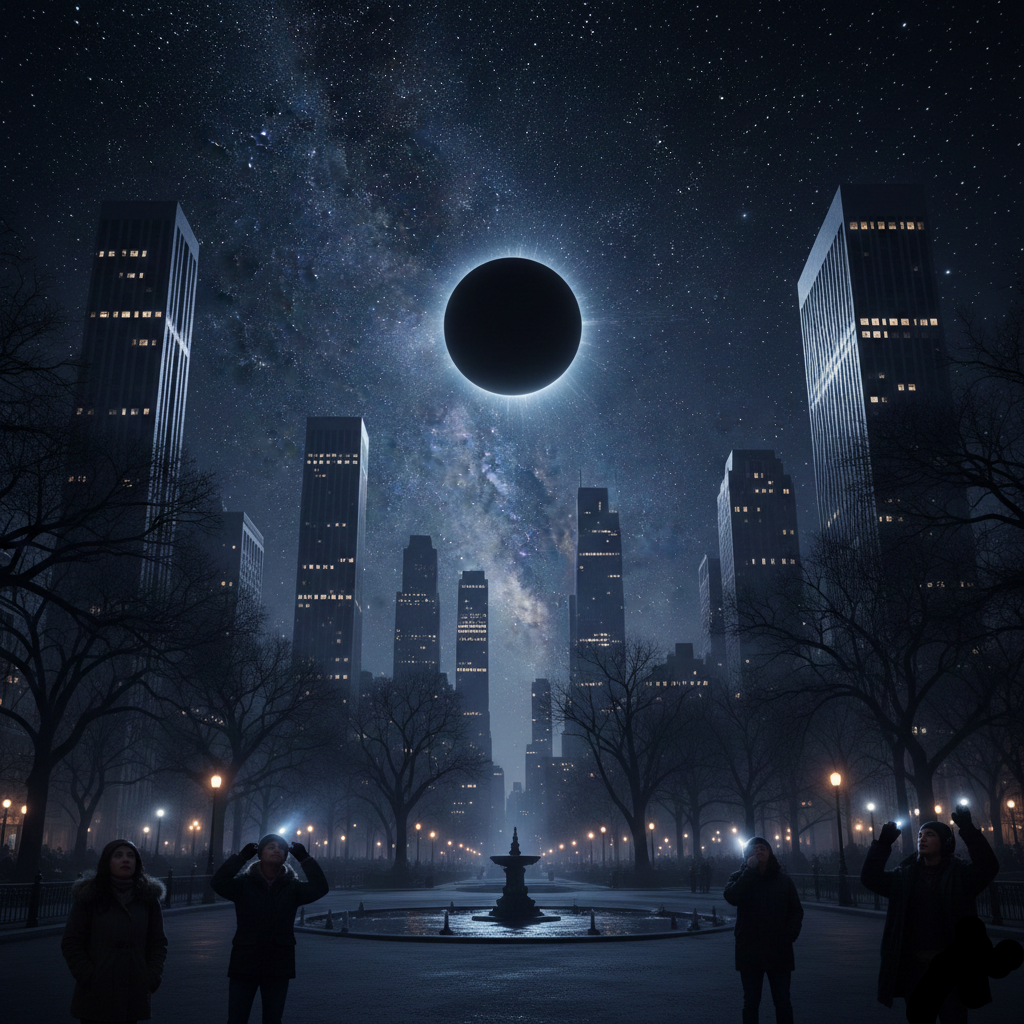
We rarely think about the Sun as a physical tether. To most of us, it’s just the big yellow lamp in the sky that dictates whether we need a jacket or a beach towel. But the reality is that every second of your life is defined by a violent, 93-million-mile-long tug-of-war. The Sun’s massive gravity keeps us from flying off into the void, while its nuclear furnace keeps us from turning into popsicles.
But what if that tether just… snapped?
If the Sun vanished right now, you wouldn’t even notice. At least, not for a few minutes. You’d finish your coffee, scroll through another TikTok, or keep typing that email. Because light, and gravity, don’t travel instantaneously. They move at a finite speed.
The Eight-Minute Grace Period
For exactly eight minutes and twenty seconds after the Sun’s hypothetical “poof” moment, everything on Earth would look totally normal. The kids would still be playing in the park; the solar panels on your roof would still be pumping out electricity.
Then, the lights go out.
It wouldn’t be like a sunset, where the colors bleed from orange to purple. It would be more like a light switch. One second it’s day, and the next, it’s a moonless, star-filled night. I say moonless because the Moon doesn’t glow on its own; it reflects sunlight. If the Sun goes dark, the Moon vanishes from the sky too.
Interestingly, gravity travels at the same speed as light. So, at the exact moment the sky goes black, the Earth would stop its elliptical orbit and start traveling in a straight line into deep space. We’d essentially become a giant, organic spaceship with no pilot and no destination.
The Deep Chill
The first few days wouldn’t actually be the “end of the world” scenario you see in Hollywood movies. The Earth is a pretty good thermal insulator. We have a thick atmosphere that holds onto heat, and the oceans are massive batteries of stored energy.
- Week One: The global average temperature would drop to about 0°C (32°F). Chilly, sure, but manageable with a good coat and some indoor heating.
- The One-Year Mark: This is where things get grim. Temperatures would likely plummet to -73°C (-100°F).
- The Final Freeze: Eventually, the Earth would stabilize at around -240°C (-400°F). At this point, the atmosphere itself would freeze and fall to the ground like a weird, nitrogen-rich snow.
Who Survives the Dark?
Plants are the first to go. Without sunlight, photosynthesis stops immediately. Small plants would die within days. Massive trees might last a few decades thanks to their slow metabolism and stored energy, but without a way to create new food, they are essentially the “walking dead” of the botanical world.
As for us? Humans are resourceful, but we’d be in a race against time. Surface life would become impossible. Our best bet would be moving underground, huddling near geothermal vents where the Earth’s core still provides heat.
The real winners, ironically, would be the creatures we rarely think about: the extremophiles living at the bottom of the ocean. These organisms don’t care about the Sun. They live off the chemical energy spewing from hydrothermal vents on the sea floor. For them, the disappearance of the Sun would be a complete non-event, at least until the oceans froze solid from the top down.
A Galaxy of Solitude
Beyond the cold and the dark, there’s the sheer loneliness of it. As the Earth drifts at 67,000 miles per hour into the interstellar medium, we would eventually leave our solar system entirely.
We would pass the orbits of Mars, Jupiter, and Pluto, becoming a “rogue planet.” These are planets that wander the galaxy without a parent star. Astronomers actually think there might be billions of these “orphan worlds” drifting through the Milky Way. It’s a haunting thought: we might just be one “bad day” away from joining their ranks.
Also read: The Big Chill: Why We Can’t Ever Quite Reach the Bottom of the Universe ?
Why This Matters
Thinking about the Sun disappearing isn’t just a fun exercise in cosmic horror. It highlights just how delicate the balance of our existence really is. We live on a pressurized rock, wrapped in a thin layer of gas, orbiting a continuous nuclear explosion.
Every bit of energy you’ve ever used, from the calories in your breakfast to the electricity powering your phone, is essentially “recycled” sunlight. Even fossil fuels are just compressed, ancient plants that captured sunlight millions of years ago. We are, in a very literal sense, creatures made of light.
So, the next time you step outside and feel the sun on your face, take a second to appreciate it. It’s not just “nice weather.” It’s the only thing keeping the nitrogen in the air from turning into snow at your feet.

One thought on “The Great Fade-Out: What Actually Happens if the Sun Quits?”