

Ever wondered why you slip on ice but not on glass? Explore the hidden science of “pre-melting” and the molecular dance that makes ice the world’s most famous lubricant.
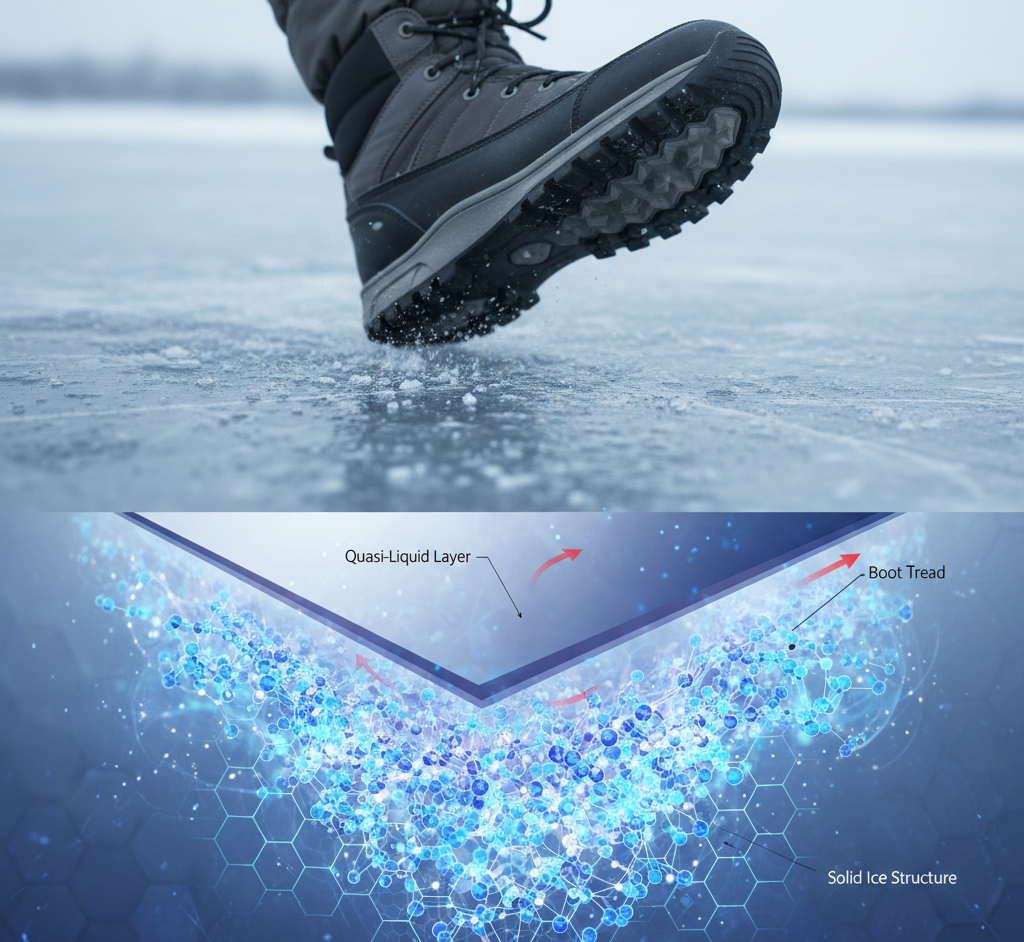
We’ve all been there: you’re walking briskly to your car, minding your own business, when suddenly your feet decide to head in opposite directions. For a split second, you’re an involuntary gymnast, flailing your arms before inevitably meeting the cold, hard pavement.
In that moment, physics is likely the last thing on your mind. You’re probably thinking about your dignity or your bruised tailbone. But once the sting fades, a fascinating question remains: why is ice so incredibly slippery?
It seems like a simple question, but the answer has stumped scientists for over 150 years. In fact, what we were taught in middle school science, and what many textbooks still say, is actually wrong.
The Myth of Pressure Melting
If you ask a well-read friend why ice is slippery, they might tell you about pressure melting. The idea is that your body weight exerts so much pressure on the ice that it lowers the melting point, turning the top layer into water.
It’s a logical guess. After all, ice is one of the few substances that expands when it freezes, meaning it’s less dense than its liquid form. If you squeeze it hard enough, it should want to turn back into a liquid.
However, there’s a massive hole in this theory. To melt ice just by standing on it, you’d need to be roughly the weight of a jumbo jet. If you’re a 150-pound human, your pressure only lowers the melting point by a fraction of a degree. It doesn’t explain why you can slip on a sidewalk when it’s a bone-chilling -10°C. If pressure melting were the only factor, ice skating would be impossible on a truly cold day.
Is it Friction? (The “Skate” Theory)
Another common explanation involves friction. As your shoe or skate slides across the ice, the friction generates heat, which melts a thin film of water.
While this definitely happens, especially when you’re a professional hockey player carving a turn at 30 miles per hour, it doesn’t explain why you slip the moment you step out of your front door. Friction requires movement to generate heat. If ice were only slippery once you were already moving, you wouldn’t lose your footing while standing still.
So, if it’s not pressure and it’s not just friction, what’s going on?
The Secret Ingredient: The “Quasi-Liquid” Layer
The real answer lies in a phenomenon called pre-melting.
Think about a crystal of ice. Inside the block, every water molecule is locked into a rigid, hexagonal cage by its neighbors. It’s a very stable, orderly neighborhood. But at the very edge, the surface where the ice meets the air, the molecules have a problem. They have neighbors below them and beside them, but nothing above them to hold them in place.
Because they aren’t “tethered” from above, these surface molecules begin to vibrate and wiggle. Even at temperatures far below freezing, the surface of ice isn’t a solid; it’s a chaotic, disordered layer of molecules that behave like a liquid.
Why this matters:
- The Marble Floor Analogy: Imagine a polished dance floor. Now imagine someone threw millions of tiny marbles across it. You aren’t slipping on the floor itself; you’re rolling on the marbles.
- Molecular Rollers: On ice, these “loose” water molecules act like microscopic ball bearings. They are too disorganized to be solid, but too attached to the ice below to be a “puddle.”
This “quasi-liquid layer” was actually first proposed by Michael Faraday back in 1850. At the time, his peers thought he was crazy. It wasn’t until the late 20th century, with the help of advanced electron microscopy, that we could actually see this layer in action.
Why Ice is Unique
You might wonder, “If surface molecules are loose on ice, why aren’t they loose on a diamond or a steel bar?”
It comes down to the way water molecules bond. They use hydrogen bonds, which are relatively strong but also very flexible. This allows the surface layer of ice to stay “wet” even when the core of the ice is deep-frozen. Most other solids are either completely locked in place or they melt all at once. Ice is special; it starts melting from the outside in, long before it reaches 0°C.
The Temperature “Sweet Spot”
Have you ever noticed that ice feels “stickier” when it’s extremely cold? If you’ve ever lived in a place like Alaska or Siberia, you know that at -40°C, ice actually provides a decent amount of grip.
This is because the quasi-liquid layer isn’t constant. As the temperature drops, that layer of “rolling marbles” gets thinner and thinner. Eventually, the molecules don’t have enough thermal energy to wiggle, and the surface becomes more like a true solid.
Conversely, ice is at its most treacherous when the temperature is right around the freezing mark. At this point, the quasi-liquid layer is at its thickest, and you might also have actual liquid water (from melting snow or sun) sitting on top. This creates a “double-whammy” of slipperiness that sends pedestrians flying.
Also read: What’s Actually Happening Inside Your Microwave ?
A New Way to Look at Winter
Next time you find yourself performing an accidental “Bambi on ice” routine, try to take a moment (after you’ve checked for bruises) to appreciate the molecular chaos beneath your feet.
We often think of the world in rigid categories: solids, liquids, and gases. But ice reminds us that nature rarely likes to stay inside the lines. The very surface of a frozen pond is a place where the rules of “solid” and “liquid” blur together in a strange, microscopic dance.
Ice isn’t just a frozen block of water; it’s a dynamic, vibrating surface that is essentially trying to melt itself from the moment it forms. We don’t slip because ice is smooth, we slip because ice is, in a very literal sense, always a little bit liquid.
