

Ever wondered why the sky is blue instead of purple or green? Dive into the simple physics of Rayleigh scattering and how our atmosphere plays with sunlight.
We’ve all done it. On a clear afternoon, you lean back, look up at that vast expanse of azure, and ask the classic “five-year-old” question: Why is the sky blue?
It’s one of those queries that feels so fundamental it almost sounds silly to ask. But the answer isn’t just a simple “because it is.” It’s actually a beautiful cosmic coincidence involving the chemistry of our air, the physics of light, and the quirky way our own eyes evolved to see the world.
If you’ve ever felt like the textbook explanations involving “scattering” were a bit too dry, let’s break it down like we’re sitting on a porch watching the sunset.
The Recipe for a Blue Sky
To understand the color of the sky, we first have to look at the ingredients. We have two main players: Sunlight and The Atmosphere.
Most of us think of sunlight as white. If you look at the Sun (please don’t do this directly!), it seems like a giant, colorless lightbulb. In reality, that “white” light is a chaotic mosh pit of every color in the rainbow. Isaac Newton famously proved this with a prism, showing that white light is just a bundle of reds, oranges, yellows, greens, blues, and violets traveling together. Each of these colors travels as a wave, but they don’t all have the same “stride.” Red light has long, lazy wavelengths. Blue and violet light, on the other hand, have short, choppy, high-energy wavelengths. This difference in “stride” is the key to everything.
Meeting the Obstacle Course
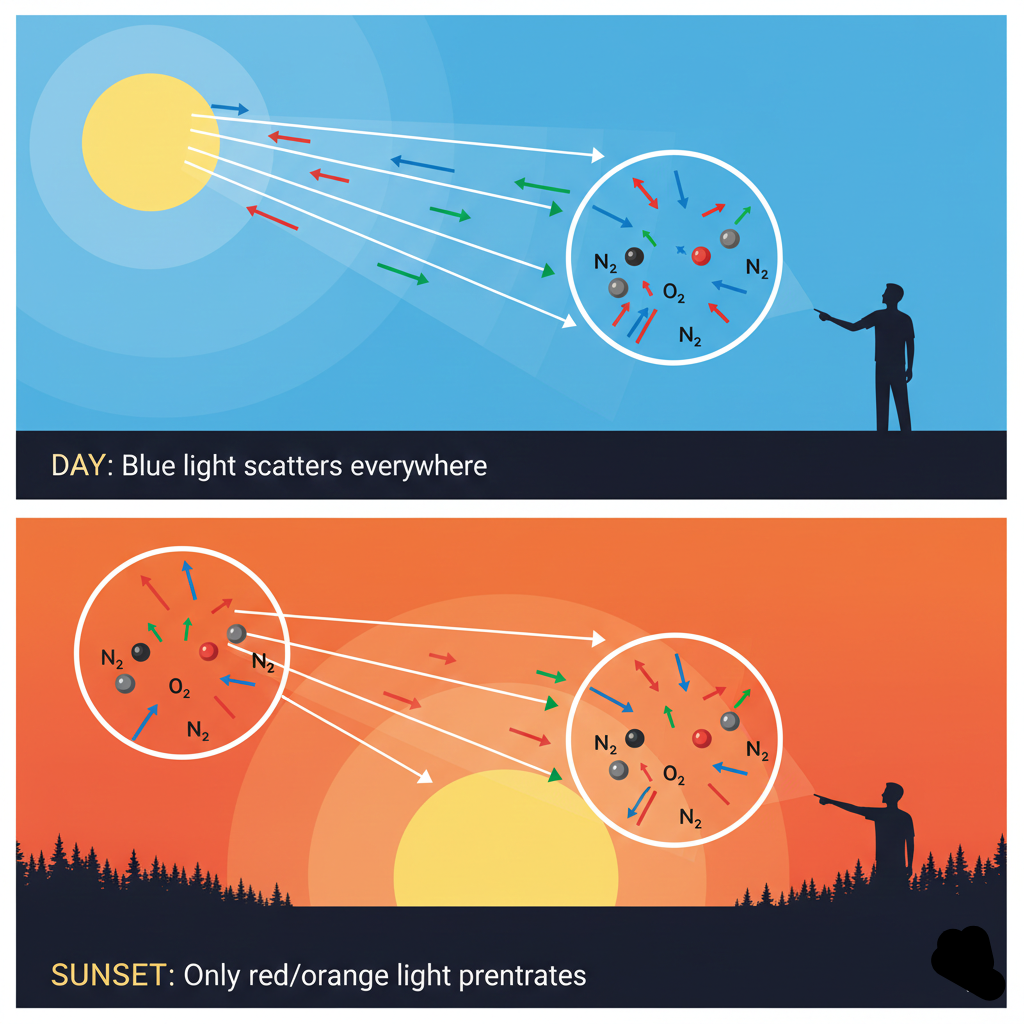
Now, imagine that bundle of light hitting our atmosphere. Our air isn’t just empty space; it’s packed with nitrogen and oxygen molecules. To a long, lanky red wave, these tiny molecules are barely an inconvenience. The red light just glides right past them, largely undisturbed. But the short, choppy blue waves? They’re a different story.
When blue light hits a nitrogen or oxygen molecule, it doesn’t just pass through. It gets “caught” and then redirected. The molecule absorbs the energy and immediately spits it back out in every possible direction. This phenomenon is called Rayleigh scattering, named after Lord Rayleigh, the British physicist who first crunched the numbers in the 19th century. Because this blue light is being bounced around like a pinball, it ends up coming at your eyes from every corner of the sky. When you look up, you aren’t seeing light coming straight from the Sun; you’re seeing the “splatter” of blue light that has been scattered across the entire dome of the atmosphere.
The “Violet” Mystery: Why Not Purple?
Here is where things get interesting. If shorter wavelengths scatter more effectively, and violet light has an even shorter wavelength than blue, then why isn’t the sky violet?
Logically, the sky should be a deep, royal purple. The physics says violet light scatters even more aggressively than blue. So why don’t we see it?
The answer has nothing to do with physics and everything to do with biology. Human eyes are simply not very sensitive to violet. We have three types of color-detecting “cones” in our retinas: red, green, and blue. Violet light stimulates our blue cones, but it also triggers our red cones slightly. More importantly, the Sun doesn’t put out an equal amount of all colors; it’s a bit “blue-heavy” compared to its “violet-output.” Between the Sun’s specific light recipe and our eyes’ bias toward blue, our brains essentially “average out” the scattered light and tell us, “Yep, that’s blue.”
The Sunset Plot Twist
If the sky is so good at scattering blue, why does it turn fiery red and orange when the Sun goes down?
Think about the path the light has to take. At noon, the Sun is directly overhead, and the light only has to travel through a relatively thin “slice” of atmosphere to reach you. Most of the blue scatters, but there’s still plenty of it reaching your eyes.
At sunset, the Sun is hugging the horizon. The light has to travel through a much longer, denser path of atmosphere to get to you. By the time that light reaches your eyes, the blue light has been scattered away so many times that it’s essentially gone. It’s been “filtered out.”
What’s left? The survivors. The long-wavelength reds and oranges that were too “lazy” to be scattered by the air molecules are the only colors that manage to make the long journey to your backyard.
Also read: Why Quantum Entanglement Is the Universe’s Weirdest Secret ?
A Pale Blue Dot
It’s worth noting that if we lived on a planet with a different atmosphere, say, one filled with giant dust particles or different gases, the sky would be a completely different hue. On Mars, for instance, the dust in the air is so large that it scatters light differently, often resulting in a pinkish-red sky during the day and a blue glow around the Sun at sunset. It’s the literal opposite of Earth.
We often take the color of our world for granted, but the blue sky is actually a fragile, beautiful signature of the specific air we breathe. It is a daily reminder that we are living inside a giant, gaseous prism.
Next time you’re outside on a clear day, take a second to look up. You aren’t just looking at “air.” You’re witnessing a billion tiny collisions happening every microsecond, a symphony of light and chemistry that just happens to paint the ceiling of our world in the perfect shade of blue.

One thought on “Why the Sky Isn’t Violet (and Other Secrets of the Blue Above)”