

We feel time passing every second, but many physicists argue it’s an illusion. Explore the “Block Universe,” entropy, and why “now” might not exist.
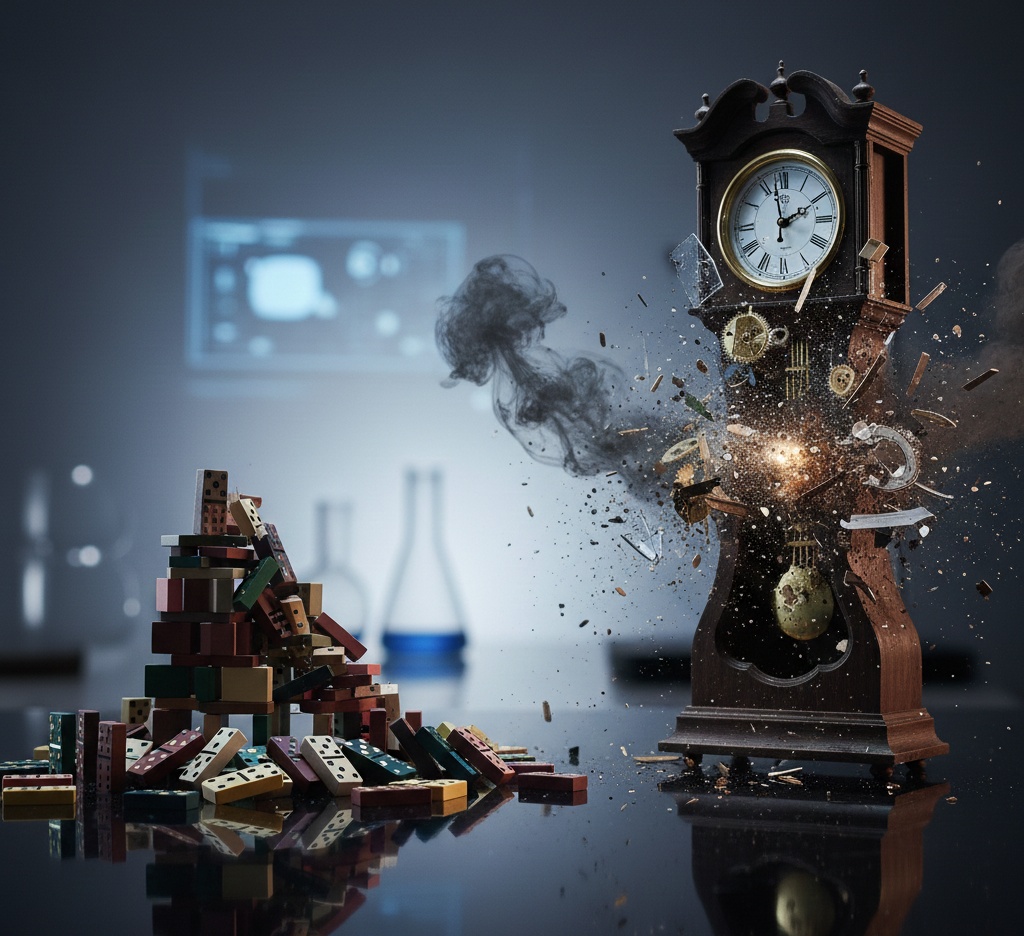
The Great Disappearing Act: Is Time an Illusion?
I was sitting in a coffee shop yesterday, watching the steam curl off my latte and listening to the rhythmic tick-tick-tick of a clock on the wall. In that moment, time felt like the most solid thing in the world. It moved in one direction, it dictated when I had to leave for my next meeting, and it definitely wasn’t waiting for me to finish my drink.
But if you ask a fundamental physicist what time is, they’ll likely give you a look that suggests you’ve just asked a very difficult question about a very shaky subject. To us, time is a river. To physics, time might just be a map, and a static one at that.
The “Now” Problem
Think about your “now.” Right now, you are reading this sentence. You feel like the past is a finished book and the future is a blank page. This “moving spotlight” of the present moment is how we experience life.
The trouble is, Einstein’s Theory of Relativity pretty much demolished the idea of a universal “now.” Einstein showed that time is flexible; it stretches and squeezes depending on how fast you’re moving or how much gravity is pulling on you.
If you were traveling on a rocket at near-light speed, your “now” would be completely out of sync with my “now” back on Earth. There is no master clock for the universe. This led physicists to the Block Universe theory: the idea that the past, present, and future all exist simultaneously in a four-dimensional “block” of space-time. In this view, 1920 is just as real as 2026; it’s just at a different coordinate.
Also read: Why the universe is running away from us ?
Why Does the River Flow One Way?
If the universe is a static block where every moment exists at once, why do we feel like we’re being pushed forward? Why don’t we ever see a broken egg un-smash itself and hop back onto the counter?
This is where the “illusion” part gets tricky. Most laws of physics are “time-symmetric.” If you played a video of two billiard balls colliding, the physics would look perfectly legal whether you played it forward or backward. There’s nothing in the fundamental equations that says time must go forward.
The one exception is the Second Law of Thermodynamics, which involves a concept called entropy.
- Low Entropy: Think of a neat stack of papers.
- High Entropy: Think of those papers scattered across the floor by a gust of wind.
The universe is moving from a state of order to a state of disorder. We perceive this increase in “messiness” as the passage of time. We remember the past because it had lower entropy, but we can’t “remember” the future because it hasn’t become messy yet. Time, in this sense, isn’t a fundamental property of the universe, it’s a byproduct of the universe’s tendency to become a giant, disorganized basement.
Is Our Brain Just Faking It?
Some researchers take it a step further. They suggest that time is a “perspectival” effect. Imagine you’re on a train looking out the window. The trees nearby are whipping past, while the distant mountains seem to barely move. The “speed” of the trees is an illusion created by your perspective.
Biologically, our brains are hardwired to stitch together a series of snapshots into a continuous movie. We need the concept of “before” and “after” to survive. If you didn’t understand that “lion lunging” comes after “lion crouching,” you wouldn’t last very long on the savannah. Our sense of time might just be a very sophisticated survival tool, a user interface that helps us navigate a 4D reality we can’t fully grasp.
The Quantum Twist
Of course, just when we think we have a handle on the “Block Universe,” quantum mechanics enters the room to break everything. At the subatomic level, things get weird. Some theories of Quantum Gravity suggest that time isn’t a primary ingredient of the universe at all. Instead, it might “emerge” from deeper, timeless interactions, much like how “temperature” isn’t a thing you can find in a single atom, but something that emerges when you have a billion atoms bumping into each other. If time isn’t fundamental, then at the deepest level of reality, nothing ever happens. Everything just is.
Living in the Illusion
So, where does that leave us? If a physicist tells you that the distinction between past, present, and future is an illusion, does it change how you feel when you’re running five minutes late?Probably not.
Even if time is a psychological construct or a thermodynamic side effect, it is the medium through which we experience love, growth, and discovery. There is a certain beauty in the idea that every moment you’ve ever lived still exists somewhere in the fabric of the cosmos, that your childhood, your first heartbreak, and the coffee you’re drinking right now are all “written” permanently into the block of the universe.
We might be living in a giant, static map, but we still get to experience the journey. And maybe that’s enough.
What do you think? If time is an illusion, does it make your “now” feel less important, or more like a permanent piece of the cosmic puzzle? I’d love to hear your thoughts in the comments below.

One thought on “Is Time Actually Real? What Physics Says About the Greatest Illusion of Our Lives”