

If you want to understand the sheer, terrifying scale of the universe, you don’t look at how big a galaxy is. You look at what happens when a single star decides it’s had enough.
In our everyday lives, we think of stars as permanent fixtures, tiny, twinkling diamonds that have always been there and always will be. But stars are actually high-stakes balancing acts. They spend millions of years locked in a desperate tug-of-war between two titanic forces: gravity, which wants to crush the star into a tiny point, and nuclear fusion, which wants to blow it apart.
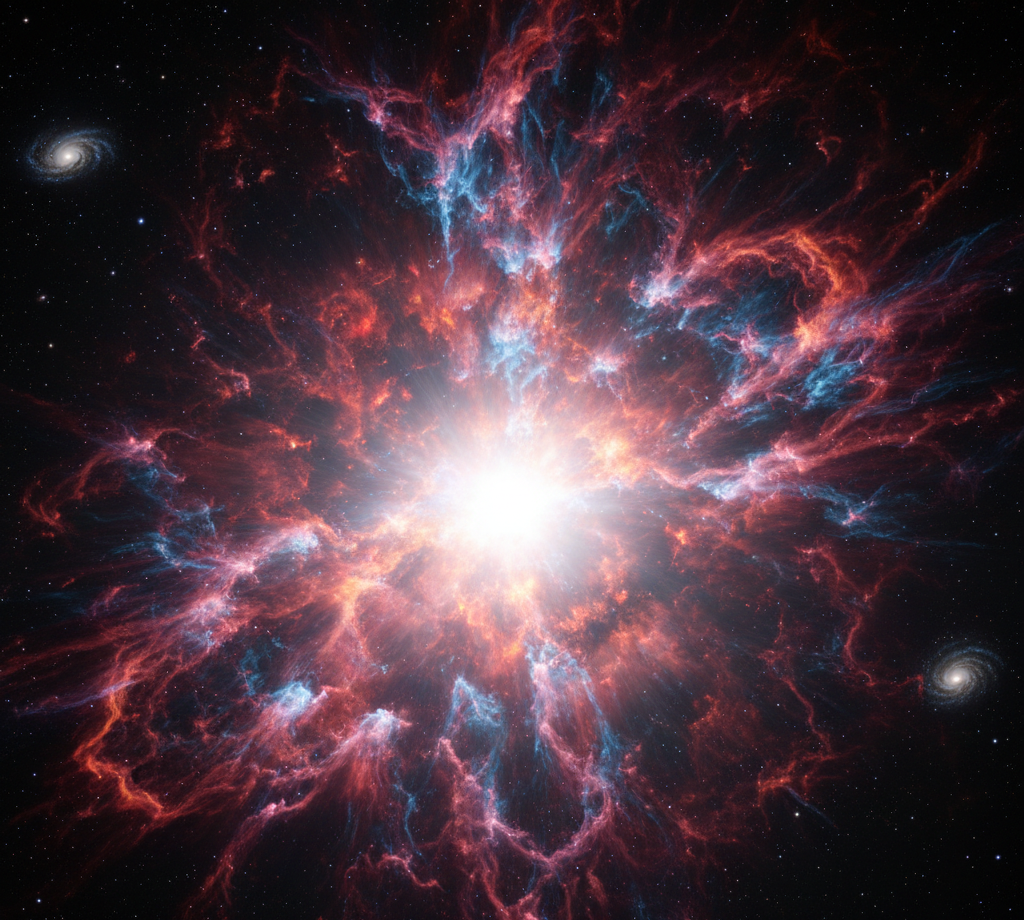
When that balance finally breaks, the result is a supernova, an explosion so bright it can momentarily outshine an entire galaxy of a hundred billion stars.
The Cosmic Pressure Cooker
To understand why a star explodes, you have to look at what’s happening in its kitchen. A massive star is essentially a factory that turns simple elements into complex ones. It starts by fusing hydrogen into helium, releasing the energy that makes it shine.
As the star runs out of hydrogen, it starts “leveling up” its fuel. It begins fusing helium into carbon, then neon, oxygen, and silicon. Each step requires more heat and pressure, and each step happens faster than the last.
But then, the star hits a literal wall: Iron.
Fusing iron doesn’t create energy; it actually consumes it. The second the star’s core turns to iron, the “outward” pressure stops. Imagine a building where every single support beam disappears at the exact same time. Gravity finally wins the tug-of-war, and the star collapses inward at about 25% the speed of light.
The Big Bounce
This is where things get truly violent. The entire mass of the star, millions of times the weight of the Earth, slams into the iron core in a fraction of a second. The core becomes so dense that the atoms themselves can’t be squeezed anymore.
The collapsing outer layers hit that solid core and “bounce” off it like a ball hitting a concrete floor. This creates a shockwave that rips the star apart, hurling its guts into the vacuum of space at millions of miles per hour.
This is a Type II Supernova. There’s also a Type Ia, which is more like a “stolen” explosion. That happens when a small, dead star (a white dwarf) literally sucks the life out of a neighboring star until it gets too heavy to hold itself together and goes pop. Either way, the result is the most energetic event in the known universe.
A History of Celestial “Guest Stars”
We haven’t seen a supernova in our own Milky Way galaxy since 1604, back when Johannes Kepler was looking through primitive telescopes. But humans have been documenting them for millennia.
In the year 1054, Chinese astronomers looked up and saw a “guest star” that appeared out of nowhere. It was so bright that people could see it during the day for three weeks, and it stayed visible in the night sky for nearly two years. Today, if you point a telescope at that exact spot, you’ll see the Crab Nebula, the glowing, shredded remains of that specific explosion.
Historically, these events were terrifying because to a medieval observer, a star appearing and then fading away was a sign that the universe was far more dynamic (and dangerous) than they ever imagined.
Is Our World Made of Death ?
Here is the part that usually makes people stop and stare at the sky: You wouldn’t be here without these explosions.
The Big Bang only created the very lightest elements, like hydrogen and helium. Every single complex atom was forged inside the heart of a dying star and then “delivered” to the universe via a supernova.
When a star explodes, it scatters those heavy elements across space. Eventually, that “stardust” clumps together to form new planets and new suns. We live in the recycled remains of a cosmic catastrophe.
Also read: Walking through walls: the strange reality of quantum tunneling.
The Final Ghost
What’s left behind after the smoke clears is perhaps the strangest part of all. If the star was big, it leaves behind a neutron star, an object so dense that a single teaspoon of it would weigh as much as a mountain. If the star was truly massive, the collapse doesn’t stop. Gravity wins so decisively that it crushes the remains into a black hole, a place where not even light can escape the wreckage.
It’s a bit poetic, isn’t it? The most brilliant light the universe can produce often leaves behind the deepest darkness imaginable.

2 thoughts on “The Day a Star Dies: The Violent, Beautiful Logic of Supernovae”