

Did you know there is an atom so rare on Earth that it was discovered… by looking at the sky? It’s helium, the second most abundant element in the universe, yet almost absent on our planet. Its story is fascinating and marks the beginning of an entirely new scientific field: astrochemistry.
It all started in 1866, in India. French astrophysicist Jules Janssen was there to observe a total solar eclipse. For just a few minutes, the sun was covered, dimming its light and offering a unique opportunity: to analyze the colors emitted by the sun using an instrument called a spectroscope.

A solar eclipse seen from Malaysia on December 26, 2019. Image credit: SADIQ ASYRAF/AFP.
To his great surprise, Janssen noticed that one color was missing in the solar spectrum: a specific yellow, at a wavelength of 587 nanometers. How could this be explained? When an atom is illuminated, it absorbs and re-emits light at certain characteristic wavelengths. So, if a color disappears in the sunlight, it means an atom in the sun absorbed it.
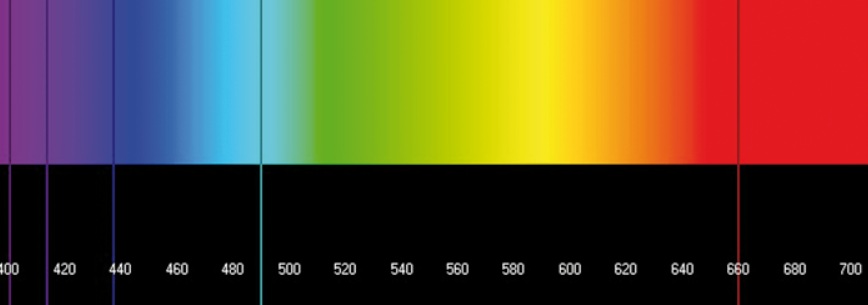
Absorption and emission spectrum of an atom.
But there was a problem: no known atom on Earth absorbed light at this wavelength. Two days later, English scientist Norman Lockyer made the same observation. With the help of a chemist, he concluded that a new element existed in the sun but had not yet been detected on Earth. He named it helium, after the Greek word Helios, meaning “sun.”
Also read: The announcement of the most detailed image of our galaxy.
It would take thirty years before helium was finally discovered on Earth, hidden in certain rocks by chemist William Ramsay. Why is it so rare here? Because helium is very light and does not bind to anything: as soon as it appears, it escapes into the atmosphere. Earthly helium mainly comes from the radioactive decay of elements like uranium, not from the Big Bang. This is why it is rare, valuable, and… expensive.
But the significance of this discovery goes beyond curiosity. It opened the way to astrochemistry, the chemistry of space. Today, scientists don’t need to stay in a laboratory to discover new elements: they observe the light emitted by stars and planets and deduce their composition. This method allows the detection of entirely new molecules, and even the search for signs of life elsewhere in the universe. For example, by analyzing the light of an exoplanet, we can identify the presence of water, organic molecules, and assess whether life could exist there.
Helium, then, is not just a light, harmless gas: it is a messenger of a chemical universe far larger than our Earth, and the starting point of a scientific adventure that continues to this day.
Source: online.

2 thoughts on “Born in the Heart of Suns: The Astonishing Journey of the Extraterrestrial Atom”